
Have you ever listened to a beautiful Naat and wished you could recite it with the same confidence, clarity, emotion, and respect?
For many people, learning Naat recitation can seem difficult at first. You may wonder whether you need a naturally beautiful voice, previous experience, or knowledge of melody and rhythm. The good news is that online Naat classes can provide a structured way to develop these skills from the comfort of your home.
With the right teacher and regular practice, students can gradually improve their pronunciation, voice control, breathing, rhythm, expression, and confidence.
In this guide, we will explain what to expect from online Naat classes, how the lessons usually work, what you can learn, who can join, and how professional guidance can help you become a more confident Naat reciter.
Who Can Join Online Naat Classes?
One of the biggest advantages of online Naat learning is that you do not necessarily need to be an experienced reciter.
A good beginner-friendly program can start from the fundamentals and gradually introduce more advanced techniques.
Online Naat classes can be suitable for:
- Children who love listening to and reciting Naats
- Teenagers interested in improving their voice
- Adults who want to learn Naat recitation
- Beginners with no previous formal training
- Students who already recite Naats but want better pronunciation
- Students preparing for school or community programs
- Individuals who want to improve Tarannum and expression
- Students who want personalized guidance from a teacher
The important thing is a willingness to learn and practice consistently.
You do not have to start with a perfect voice. In fact, one purpose of structured training is to help you understand how to use and control your existing voice more effectively.
What Are Online Naat Classes?
Online Naat classes are live learning sessions in which students learn the art of Naat recitation through the internet.
Instead of travelling to a physical academy, students can connect with a Naat teacher from home using a computer, tablet, or smartphone.
A structured online Naat program may cover several important areas, including:
- Naat pronunciation and clear diction
- Voice control
- Breathing techniques
- Melody and rhythm
- Tarannum
- Understanding Naat poetry
- Emotional expression
- Recitation practice
- Confidence building
- Performance preparation
- Teacher feedback and correction
At Nurjan Quran Academy’s Naat Course, students can learn these skills through a structured curriculum designed for beginners as well as students who want to improve their existing recitation abilities. The course includes topics such as voice training, breath control, pronunciation, Tarannum, poetry understanding, emotional delivery, performance practice, and assessment.
What to Expect in Your First Online Naat Class
Your first class may feel slightly different from a traditional classroom because you will be learning through a screen.
However, the learning process can still be interactive and personalized.
1. Introduction and Student Assessment
A teacher may first ask about your previous experience.
For example:
- Have you recited Naats before?
- Which Naats do you like?
- Are you a complete beginner?
- What pronunciation difficulties do you have?
- Do you want to improve your voice or Tarannum?
- Are you preparing for a particular performance?
This helps the teacher understand your current level.
A beginner may start with basic exercises, while a more experienced student may move toward pronunciation, melody, expression, and performance techniques.
2. Learning Correct Pronunciation
Pronunciation is one of the most important parts of Naat recitation.
A beautiful melody cannot compensate for unclear or incorrect pronunciation.
During an online Naat lesson, your teacher may listen carefully to individual words and phrases and point out areas that need improvement.
You may practice:
Teacher recites → Student repeats → Teacher corrects → Student practices again
This listen-and-repeat approach can make online learning highly practical.
For students who also want to strengthen their Quranic pronunciation, our Online Tajweed Course can provide additional training in articulation points and pronunciation principles.
3. Voice Training and Breath Control
You may be surprised to learn that good Naat recitation is not simply about having a naturally beautiful voice.
Voice control plays an important role.
Students may work on:
- Breathing properly
- Controlling airflow
- Maintaining a steady voice
- Avoiding unnecessary strain
- Improving vocal stability
- Practicing suitable pitch
- Making transitions smoother
Breath control is especially useful when reciting longer lines.
Instead of running out of breath in the middle of a phrase, students learn how to manage breathing more effectively.

4. Learning Tarannum, Melody and Rhythm
Another important part of Naat recitation is Tarannum, or the melodic style used during recitation.
Beginners may initially find melody difficult. A teacher can simplify the process by breaking a Naat into smaller sections.
For example:
- Listen to the teacher.
- Repeat one line.
- Practice the melody.
- Correct the rhythm.
- Repeat the line independently.
- Connect it with the next line.
This gradual method can make complex melodies easier to understand.
The goal should not simply be to imitate a sound. Students should gradually develop control, understanding, and confidence in their own recitation.
5. Understanding the Meaning of Naat Poetry
Naat is poetry expressing love, respect, and praise for the Prophet Muhammad (PBUH).
Understanding the words can make a major difference in how you recite them. When students understand what they are saying, they can better appreciate:
- The message of the poetry
- The emotion behind each verse
- The appropriate tone
- Where to pause
- Which words require emphasis
- How the overall meaning connects together
This is one reason language skills can complement Naat learning.
If you or your child wants to improve Urdu reading and comprehension, you can also explore our Online Urdu Course, which includes reading, writing, speaking, comprehension, and exposure to Islamic literature and Naat.
6. Expression and Emotional Delivery
A Naat should not feel like someone is simply reading words from a page.
Expression helps communicate the feeling contained within the poetry.
During online Naat lessons, students can learn how to improve:
- Voice modulation
- Pauses
- Tone
- Emphasis
- Facial expression
- Emotional connection
- Overall delivery
The objective is to develop a respectful and natural style rather than forcing emotion into every line.
A skilled teacher can help a student understand where a particular verse needs a softer tone, stronger emphasis, or a natural pause.
7. Practicing Complete Naats
Once you understand individual techniques, your teacher may help you put everything together.
You may begin with a short Naat and gradually progress toward longer compositions.
A typical practice session could include:
Pronunciation → Melody → Rhythm → Breathing → Expression → Complete Recitation
At this stage, the teacher can identify mistakes that may not be noticeable when practicing individual lines.
8. Regular Teacher Feedback
One of the major benefits of learning Naat with a teacher is receiving direct feedback.W
hen practicing alone, it can be difficult to identify your own mistakes.
A teacher can help you recognize issues such as:
- Incorrect pronunciation
- Unsteady rhythm
- Weak breath control
- Unclear words
- Inconsistent pitch
- Unnatural pauses
- Lack of confidence
Regular correction allows students to improve gradually rather than repeatedly practicing the same mistake.
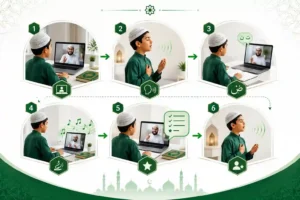
How Does an Online Naat Class Work?
The exact format can vary between academies, but a structured online class may follow a simple process.
Step 1: Connect With Your Teacher
You join the class using your phone, tablet, or computer.
Step 2: Warm-Up
The teacher may begin with simple voice or breathing exercises.
Step 3: Review Previous Work
The teacher listens to the Naat or verses practiced during the previous lesson.
Step 4: Learn a New Section
A new line, verse, melody, pronunciation point, or technique is introduced.
Step 5: Practice
The student repeats the material with teacher guidance.
Step 6: Correction
The teacher identifies areas that need improvement.
Step 7: Independent Recitation
The student recites without immediate prompting to demonstrate understanding.
Step 8: Practice Assignment
The student receives material to practice before the next lesson.
This structured approach helps transform each lesson into a continuous learning process.
One-to-One vs Group Naat Classes
When choosing online Naat classes, you may come across both one-to-one and group lessons.
One-to-One Naat Classes
One-to-one classes provide direct attention from the teacher.
They can be particularly useful when a student needs help with:
- Pronunciation
- Voice control
- Specific melodies
- Confidence
- Individual weaknesses
- Performance preparation
The teacher can adjust the pace according to the student’s needs.
Group Naat Classes
Group classes allow students to learn alongside others.
They can help students:
- Listen to different recitation styles
- Practice together
- Build confidence
- Develop a sense of participation
- Learn in a social environment
The best option depends on the student’s age, goals, learning style, and preferred level of individual attention.
What Equipment Do You Need for Online Naat Classes?
You do not need an expensive studio to begin.
A basic setup can be enough:
- Smartphone, tablet, or computer
- Stable internet connection
- Headphones or earphones
- Quiet room
- Comfortable seating
- Notebook for taking notes
A good microphone can be helpful, particularly when the student is working seriously on voice quality, but beginners can usually start with the equipment they already have.
The most important factor is being able to hear the teacher clearly and allowing the teacher to hear the student’s recitation properly.
How Long Does It Take to Learn Naat Recitation?
There is no single answer because every student is different.
Your progress may depend on:
- Previous experience
- Age
- Practice frequency
- Pronunciation ability
- Voice control
- Understanding of rhythm
- Confidence
- Consistency
- Teacher guidance
A complete beginner should not compare their progress with an experienced Naat Khawan.
Instead, focus on gradual improvement.
You might first learn one verse correctly, then one complete Naat, and eventually become comfortable performing in front of others.
Consistency is more valuable than trying to master everything in a few days.
How Much Should You Practice Between Classes?
Regular practice is essential.
Even a short practice session can be useful when performed consistently.
For beginners, practice can focus on:
5–10 minutes: Breathing and voice exercises
10–15 minutes: Pronunciation and difficult words
10–15 minutes: Naat melody and rhythm
5–10 minutes: Complete recitation
The exact practice schedule should be adjusted according to your age, ability, and teacher’s recommendations.
Rather than practicing for a long time once a week, regular short sessions can help build familiarity and confidence.
What Progress Can You Expect?
With regular lessons and practice, students may gradually develop several skills.
Better Pronunciation
You can become more aware of how individual words should be articulated.
Improved Voice Control
You can learn how to control breathing, volume, tone, and pitch.
Better Rhythm
You can become more comfortable maintaining the rhythm of a Naat.
Greater Confidence
Regular practice with a teacher can reduce hesitation when reciting.
Stronger Expression
Understanding the poetry can help you deliver verses more naturally.
Performance Readiness
With enough practice, you may feel more comfortable reciting in front of family, classmates, or a community audience.
Can Children Learn Naat Online?
Yes. Online Naat classes can be a convenient option for children who enjoy Islamic poetry and want to improve their recitation.
Children may benefit from:
- Short and engaging lessons
- Simple Naats
- Repetition-based learning
- Positive encouragement
- Voice exercises
- Regular teacher feedback
- Gradual performance practice
Parents should choose a course that uses age-appropriate teaching methods and does not overwhelm the child.
At Nurjan Quran Academy, the Naat Course is structured for both children and adults, with the course listing an age range from 6 to 60+ and offering one-to-one and group formats.

Can Adults Learn Naat Recitation?
Absolutely.
Adults sometimes assume that they are too old to learn because they have never received formal training.
That is not necessarily the case.
Adults can begin with basic pronunciation, breathing, voice control, and simple melodies before progressing toward more advanced recitation.
Online learning can be particularly convenient for adults because they can study from home without travelling to a physical academy.
How Naat Classes Can Complement Quran Learning
Naat learning and Quran learning are different areas, but some foundational skills can complement each other.
For example, students who are working on pronunciation, Arabic articulation, voice control, or general recitation may find additional Quranic study beneficial.
If you or your child is still developing basic Quran reading skills, consider starting with the Noorani Qaida Course.
Students who already have a foundation can continue with the Quran Recitation Course to work on fluent and accurate Quran reading.
For students interested in memorizing the Quran, the Quran Memorisation Course provides structured Hifz learning with new lessons, revision, testing, and retention strategies..
Why Choose Online Naat Classes Instead of Learning Alone?
You can certainly listen to Naats and practice by yourself.
However, self-learning has one major limitation: you may not know which mistakes you are making.
A teacher provides another set of ears and can identify problems that you may not notice.
With guided learning, you can receive:
- Personalized correction
- Structured lessons
- Pronunciation guidance
- Melody practice
- Voice training
- Regular feedback
- Performance preparation
- A clear learning path
Instead of randomly practicing different Naats, you can follow a step-by-step approach.
How to Choose the Right Online Naat Course
Before joining an online Naat academy, consider the following questions.
1. Is the course suitable for beginners?
If you are starting from zero, look for a program that teaches the fundamentals rather than assuming previous knowledge.
2. Does the teacher provide individual feedback?
Feedback is particularly important for pronunciation, melody, and voice control.
3. Does the curriculum cover more than memorizing Naats?
A good course should ideally develop broader skills such as voice control, Tarannum, pronunciation, expression, and performance.
4. Are children and adults accommodated?
If you are enrolling a child, check whether the teaching approach is appropriate for their age.
5. Is the class schedule convenient?
Online learning should make education more accessible, so choose timings that your family can maintain consistently.
6. Is there a structured curriculum?
A clear curriculum makes it easier to understand what you are learning and how you are progressing.
7. Does the academy offer a trial?
A trial lesson can help you determine whether the teacher’s teaching style is suitable for you or your child.
What Makes a Good Naat Teacher?
A good Naat teacher should do more than simply recite beautifully.
They should be able to explain and demonstrate the techniques students need to develop.
Look for qualities such as:
- Strong Naat recitation skills
- Clear pronunciation
- Patience
- Good communication
- Ability to teach beginners
- Understanding of Tarannum
- Voice training knowledge
- Ability to give constructive feedback
- Experience teaching children when relevant
- Respectful understanding of Naat and Islamic etiquette
The teacher-student relationship is important because improvement requires regular correction and encouragement.
Online Naat Classes at Nurjan Quran Academy
At Nurjan Quran Academy, the Online Naat Course is designed to help students learn the art of Naat recitation in a structured way.
The curriculum includes:
- Introduction to Naat and its history
- Voice training and breath control
- Basic melodies and rhythms
- Pronunciation and clear diction
- Learning traditional Naats
- Understanding poetry and lyrics
- Expression and emotional delivery
- Performance practice
- Recitation assessment and feedback
The course is designed for beginners as well as students who want to improve their existing skills, and it is available for children and adults.
If you are looking for a structured way to learn Naat online, you can explore the full Naat Course at Nurjan Quran Academy.
A Simple Learning Path for New Naat Students
If you are completely new to Naat recitation, you can follow a simple progression:
Stage 1 – Foundation
Learn pronunciation, breathing, and basic voice control.
Stage 2 – Rhythm
Practice simple melodies and rhythmic patterns.
Stage 3 – Poetry
Understand the words and meaning of the Naat.
Stage 4 – Expression
Learn how to deliver the poetry naturally and respectfully.
Stage 5 – Complete Recitation
Combine pronunciation, breathing, melody, rhythm, and expression.
Stage 6 – Performance
Build enough confidence to recite in front of others.
This approach allows students to focus on one skill at a time instead of trying to master everything simultaneously.
Final Thoughts
Learning Naat is more than memorizing words and copying a melody.
It is an opportunity to develop recitation skills while appreciating the poetry, meaning, respect, and devotion behind the Naat.
Online Naat classes make this learning experience accessible to children and adults who want structured guidance without travelling to a physical academy.
With the right teacher, regular practice, and patience, beginners can gradually improve their pronunciation, voice control, Tarannum, rhythm, expression, and confidence.
If you are ready to begin your journey, explore the Naat Course at Nurjan Quran Academy and discover how structured online lessons can help you develop your Naat recitation skills from home.
How Nurjan Quran Academy Turns These Lessons into Success
Avoiding these common mistakes begins with choosing the right academy. At Nurjan Quran Academy, we don’t just teach—we build lifelong connections to the Quran.
For students in the USA, UK, Canada, and across Europe: Join a learning environment where technology meets tradition, and convenience never compromises quality.
📞 Take the next step: Book a free trial class today. Experience our teaching method, meet your potential tutor, and see how we tailor lessons for your success—whether in Quranic recitation, Hifz, Tafsir, or the beautiful art of Naat.
Embrace your Quranic journey with confidence. Avoid the pitfalls. Start strong, stay consistent, and let every letter bring you closer to Allah.
FAQ's
Frequently Asked Questions
We understand you might have questions about starting your journey with the Naat. Below, we’ve answered some of the most common queries to help you get started with confidence and clarity.
Yes. Beginner-friendly Naat courses can start with basic pronunciation, breathing, voice control, and simple recitation techniques before progressing to more advanced skills.
No. A naturally pleasant voice can be helpful, but training can help students improve voice control, breathing, pitch, rhythm, and delivery.
Yes. Children can learn Naat through age-appropriate lessons, repetition, practice, and encouragement. The learning pace should be adjusted according to the child's age and ability.
Depending on the course, you may learn pronunciation, voice training, breath control, Tarannum, rhythm, poetry understanding, emotional delivery, performance techniques, and recitation practice.
Yes. Adults can begin with the fundamentals and progress gradually with regular practice and teacher guidance.
Yes. Many students choose to study both. Quran recitation and Naat are separate learning areas, but pronunciation, articulation, and general recitation skills can complement one another.